
This is the Homepage of the "Beginners chess guide"
Chess is a strategy game played on an 8x8 board where two players face-off with pieces.The goal is to outmaneuver your opponent, control key spaces, and ultimately trap their king in checkmate.
Chess is a game of memorization, calculation, and long term planning.
Making chess both easy to learn for keen beginners (most likely you),
and endlessly challenging for those who want to go into the grandmaster level.
"are there any competitive chess games or tournaments?"
Yes, there are multiple online and over-the-board competitve chess games and tournaments.FIDE (Federation Internationale Des Echecs in French, or International Chess Federation for english).
FIDE regulates chess competitions, sets official rules of play, calculates official Elo ratings, and organizes major events like the World Chess Championship.
Some of the most known events are the World chess "classical" Championship, World cup, Grand swiss, and the "Candidates".
There are thousands of other global tournaments and there are some in NZ too like the BOP tournament.
Basic Fundementals of chess
Each side has 8 pawns, 2 rooks, 2 bishops, 2 knights, 1 queen, and 1 king.They can also preform a special move called "en passant" (In passing for english) where if one of your opponents pawns moves 2 squares up from it's starting square and one of your pawns are next to the pawn that has just moved, you can capture the pawn by moving your pawn behind the opponents pawn.
And if your pawn reaches the other side of the board it can promote to another piece like a queen, or underpromote to a rook, knight, or bishop.
All pieces have their own notation, nothing=pawn, N=knight, B=Bishop, R=Rook, Q=Queen, K=King. A knight move would look like Nf4 and a rook move would look like Rh6 symbolizing that the piece it notates has moved to that square on the board.
X= a capture, It means the move you played has captured a piece on the board and will look like Rxb2 symbolizing a rook has captured a piece on b2.
+=Check, it's when you check the king like Be4+ symbolizing you have moved a bishop to e4 to check the king.
#=checkmate, Checkmate is the ultimate blow to your opponent and would look like Qg2# symbolizing that you have moved the queen to g2 for mate.
1/2= stalemate, a draw.
E.P= En passant, the special pawn move andwould look like exd4 normally without E.P.
0-0 and 0-0-0= Castle or long castle, it shows that you have castled with the kings rook (0-0) or the queens rook (0-0-0).
e8=Q= a pawn has premoted to a queen. There are other promotions called underpromotions where you would promote to another piece that isn't a queen like e8=R for rook, e8=N for knight, and e8=B for bishop. You'd usually do this rarely for some type of brilliant move for checkmate or a discovered attack.
Finally if 2 of any of the same piece can see a square you moved to it would be notated as Nfd6 symbolizing that a knight on the f file went to d6 when another knight of yours also saw that square or maybe Q3h2 to symbolize that 2 queens on the same file can move to the same square but the one on the 3rd rank is the one that moved.
all the moves (chess.com wise):
Chess Fun Facts
1) The Rarest Checkmate possible is called the Doubly disambiguated bishop checkmate.It's exceedingly diificult because you need 3 bishops of the same coloured squares lined up in a corner with the opponents king in the corner.
A queen that needs to have a discovered checkmate available from the Bishop.
And a piece that the bishop takes when the final move is played. If all is done then the chess notation should be something like "Bh1xg2#".
2) The most popular chess game is called the Immortal played by Adolf Anderssen (white) and Lionel Kieseritzky (black).
It's known as the most popular because Adolf Anderssen sacrificed 1 bishop, 2 rooks, and his queen to deliever what is believed to be, "the most beautiful checkmate ever played".
3) The most debated fact in chess is "who's the best player in history?"
Some say Magnus Carlsen for having the highest FIDE Elo in history of 2882,
some say Bobby Fischer due to his absolute dominance over chess in the early 1970's, even conquering the Soviet Union without the help of todays AI and Chess Engines.
others say Garry Kasparov for his Genius and mental capacity to think over 20 moves ahead, whoever you debate for is your choice.
4) There are more possible chess games than there are atoms in the universe. This is know as the "shannon number".
5) Most famous move played was on July 11, 1972 when bobby fischer (black) and Boris Spassky (white) played in a championship and on move 29 fischer played Bxh2(?), trapping his own bishop and losing it. This move is known as the "bishop blunder". It's famous because fischer was known as an almost unstoppable player and to see him make this rookie mistake was shocking for the entire chess world.
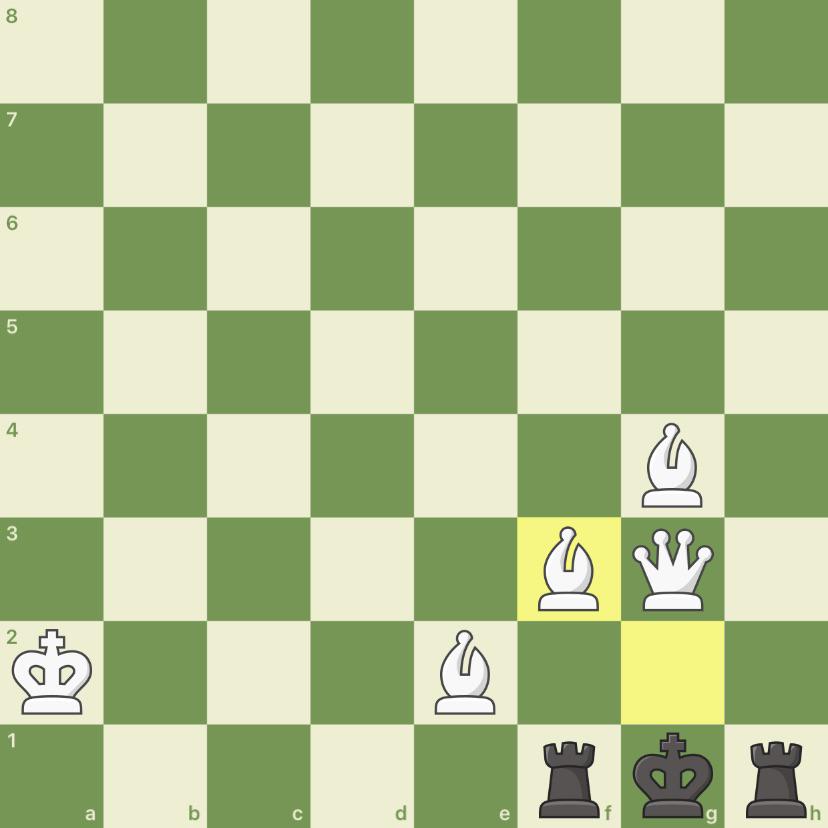 This is image is of the "doubly disambiguated bishop checkmate"
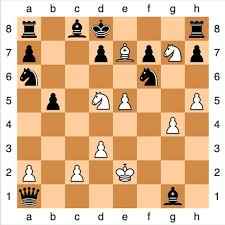 This Image is of the final move in the "Immortal game".